
When Leif and I got back from our trip we had taken just over 1200 photographs and 200 videos. Over the years we have determined that for every good shot we get there are at least five or six that are crap. It is about that for this trip as well. I will try to be judicious in what I post up here so as not to overload you with photographs that aren't very interesting to look at.
We had so many great experiences (and one not-so-great-almost-turned-terrible experience) that I will probably write about them in bits and pieces. But I have to say that even though two weeks is not all that long, we really grew to love Honduras and especially the individuals who lived there. They are really beautiful and kind people. We hope to be able to return one day.
So, on to the first of several long (sorry, you can always just skip down to the photographs) posts about our trip.
We had so many great experiences (and one not-so-great-almost-turned-terrible experience) that I will probably write about them in bits and pieces. But I have to say that even though two weeks is not all that long, we really grew to love Honduras and especially the individuals who lived there. They are really beautiful and kind people. We hope to be able to return one day.
So, on to the first of several long (sorry, you can always just skip down to the photographs) posts about our trip.
............................................................................................................................................
Surely two days is not enough time to spend in a place like the Mayan city of Copan. It is huge and breathtaking and intimidating and lovely and sad. But two days is all we had in what is often referred to as the Paris of the Mayan world. We were fortunate, however, that the two days we did have turned out to be pretty spectacular.
I don't know much about tourism in Honduras but I am fairly certain that it isn't often that people find themselves to be one of only a handful of visitors to what is considered by many to be the most beautiful of all ancient Mayan cities. Maybe it was because it was toward the end of their main tourist season but when we arrived to the ruins on our first day we were amazed and counted ourselves to be very lucky in that there was hardly anyone else around. The day started out with a couple of other groups but as the day pressed on into afternoon we found ourselves, aside from the men working there, to be the only two people wandering around, gaping at the stone edifices.
Leif and I are admittedly not well versed in the history of the Mayan culture, although I did receive a quick lesson from a friend who lived in Belize for a year helping at a Mayan archeological site. We decided that without a guide of some sort whatever we saw would make about as much sense to us as if we were to stumble upon an alien spacecraft deep in the jungle. As it turned out we happened to hire a guide who had been giving tours there for nearly thirty-five years and probably knew just about as much Mayan history as any PhD in Archeology. Although his formal education was limited, Tony spoke fluent Spanish, English, German, French, Italian, and spoke passable Russian, Japanese, and Mandarin. He also, as he told us at least three times during the tour, is in the Guinness World Records for being able to give a greeting in the most languages*, has three sons (one of whom died six years ago and one of whom is very fat, according to him), and has met a Japanese princess.
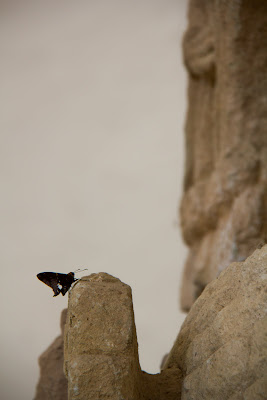
Our three hours with him were not solely spent discussing his personal life. He did talk about the site, of course. But somehow I think it reads as less interesting as Tony's self-proclamations. For the history of Copan, Wikipedia is more thorough than I can ever hope to be. The one thing that he did tell us about the Mayans, which I find particularly interesting and will pass on here, is that they held the belief that when one of their warriors died, his soul took the form of a butterfly to make its journey into the afterlife. This is a concept that isn't too difficult to understand how they came up with if you are able to spend even five minutes there. Simply everywhere you look there are hundreds butterflies of perhaps a dozen or so types.
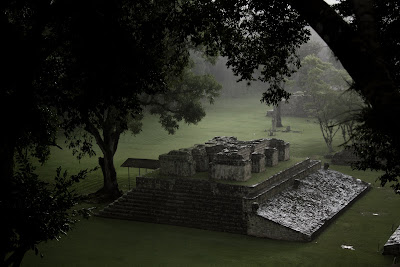
Toward late afternoon, long after our tour with Tony ended and not long after a longish conversation in Spanish (I often compare my Spanish to that of a drunken toddler) with a young guy named Nelson in which we talked about how his daughter is named after a red-headed American doctor who relieved his wife of kidney stones so that she was soon after able to become pregnant, we were completely alone and it began to rain heavily. I found out from Nelson later that when it starts to rain that heavily and the lightening and the thunder begins they all generally clear out for fear of being struck by lightening, which we did not do. Oops. Instead we ended up climbing to the top of the tallest temple and took photographs until I got scared and forced a retreat back down the slippery stone. But for those moments, alone atop that stone structure thousands of years old looking out upon an empty courtyard, I felt like we were experiencing something pretty unique and special.

.L.
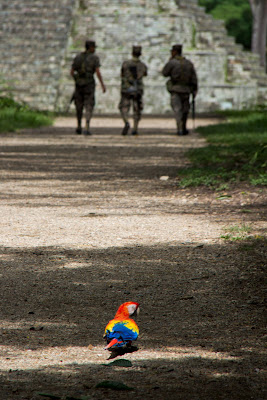
At the entrance to the site there were maybe ten parrots all perched along the fence, noisily awaiting treats from passersby. This guy got tired of waiting for someone to feed him but he couldn't fly so he had to walk down the path to where they had their feeding buckets set up. The soldiers in the background were walking toward the ruins themselves, presumably to do some sort of security rounds, all the while playing with the rifles. Bizarre.

.L.
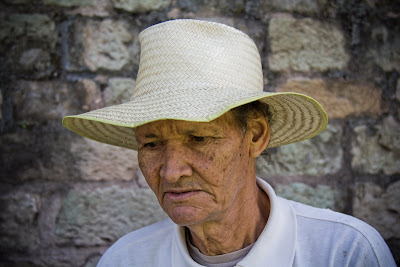
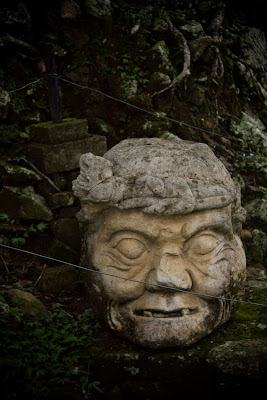
Our linguistically inclined guide, Tony. He was missing his front two teeth and, by his own declaration, looked strikingly like the old-man statue below.

.L.

.L.
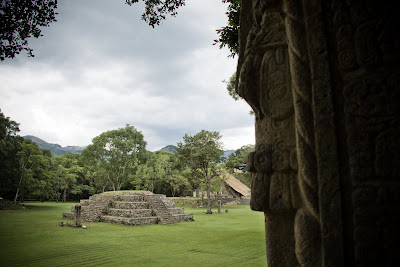
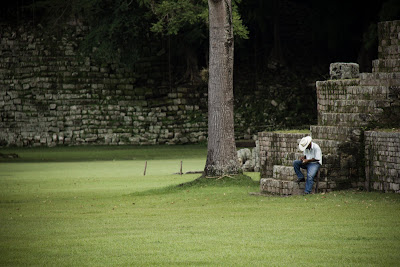
Although the grass is beautifully manicured now, during the time when the city was occupied by its architects, the entire ground was plastered over such that it was completely devoid of vegetation within its boundaries.

.B.


.L.
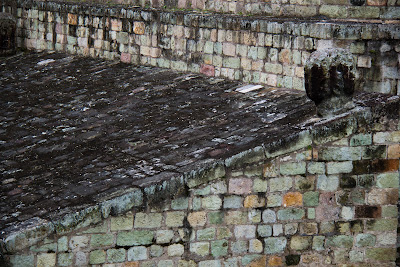
These two images are of the ball court where they would play their games and sometimes, depending on the significance, the winning or the losing team members would lose their heads.

.L.
The view from the top of the temple.

.B.
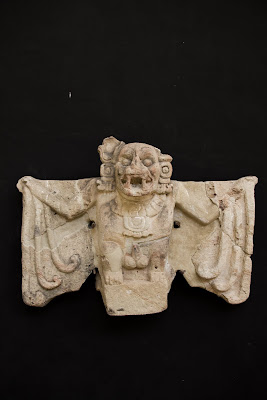
A very well endowed bat sculpture at the onsite museum. Not a critter you would want to come across alone, for a variety of obvious reasons.

.L.

.B.

.L.
*I have since looked into Tony's claim to fame only to find that the online website is not as thorough about keeping records as one would suppose from an organization that records facts and feats as it's main purpose. Subsequently, I did not find anything that would validate his claim but I tend to believe him anyway. I did find that the most nationalities in a sauna is 57, a record set in 2008 in Japan (where else?). I also found that the most Ferrero Rocher chocolates to be eaten in one minute is seven. A number to which I scoff at and think that perhaps I should try to set my own record for eating those little treats.

Amazing photographs. It looks (and sounds) incredible. I'm looking forward to reading more about your trip.
ReplyDeleteAMAZING. Thank you for sharing and making me drool.
ReplyDeleteAnd yes, I am sure you can beat that Ferrero Rocher record. :-)